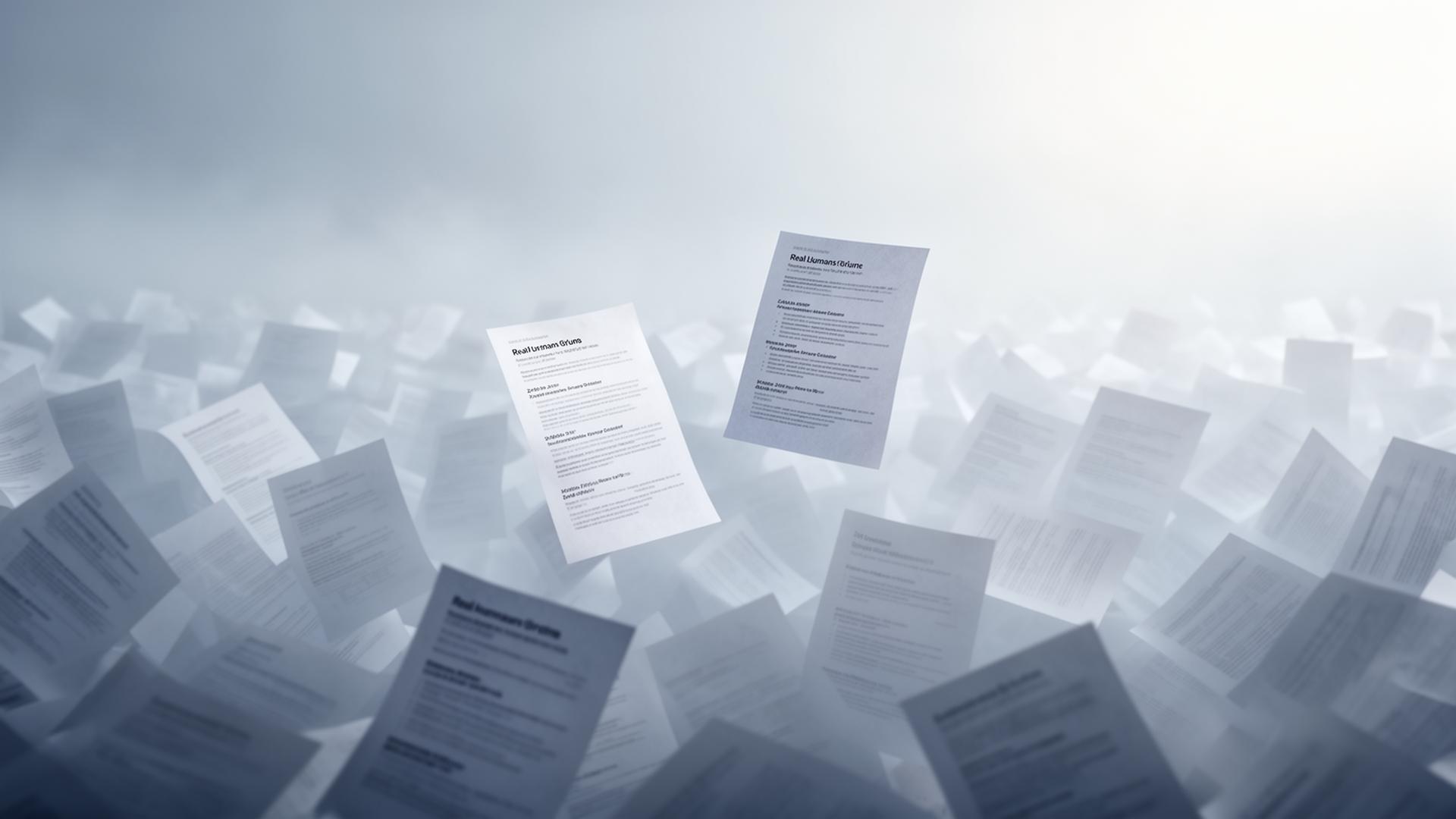
Stop the AI CV blast.
Read the humans.
Auto-apply tools let one job seeker send the same CV to 500 openings in a single click. We flag those before you open them, so the candidate who actually wrote to you rises to the top.
We're hand-picking our first design-partner teams. No fake counters, no spam — one email when early access opens.
Application Review47 new
Illustrative preview · Greenhouse-style integration shown
This isn't a vibe — it's a flood
The inbox math stopped working in 2025.
One job seeker can now blast the same CV to hundreds of openings in a single click. The volume is real, it's measured, and it's burying your best people.
more job applications on LinkedIn than a year ago — about 11,000 every minute.
LinkedIn / CNBC, 2025 ↗applications hit a single role within 24h — and 70% don't meet the basic criteria.
LinkedIn / CNBC, 2025 ↗Why your ATS filters can't stop it: one auto-apply bot fires off thousands of applications in a click — and deliberately randomizes timing and swaps file names to slip past each platform's checks. No single inbox can see the same CV landing in 500 others. A network can.
Auto-apply tooling & evasion behavior: LazyApply, 2025 ↗
How it works
We never read the CV. We read the pattern.
Local fingerprinting
When a CV lands in your ATS, we hash it locally into a short, anonymous fingerprint. The contents — names, history, contact — never leave your environment.
Network check
That fingerprint is matched against an anonymized network of other recruiters. If the same CV hit 500 inboxes in the last 24 hours, you'll know.
Ephemeral by design
Fingerprints expire within a few weeks. There's no permanent record — candidates can keep applying naturally over time without being flagged forever.
Built for privacy
We don't want your candidates' data.
We help you find the people who actually wrote to you — not the ones who scripted their way into every inbox. To do that, we never need the CV itself. No resumes stored, no PII ingested, no profiles built.
We never read the CV
The document is hashed into a short, anonymous fingerprint inside your environment. Names, history and contact details never reach us.
No storage of PIIJust a pattern, not a person
All we compare is whether the same fingerprint showed up across many inboxes. There's no profile to build and nothing to sell.
GDPR-native by designForgotten in weeks
Fingerprints expire automatically, so candidates can keep applying naturally over time and are never flagged forever.
Auto-expiry built in
Why I'm building this
I started this after watching people I deeply respect — sharp engineers and designers — disappear into the pile. They'd send one real, careful application. Meanwhile a bot fired off the same CV to 500 companies before lunch. Guess whose application the recruiter saw first.
humanbehind.cv isn't about keeping people out. It's about making sure the person who actually wanted your role doesn't get drowned out by someone who automated their way into every inbox on the internet. Hire the human. That's the whole idea.
Honest questions, honest answers
Isn't this unfair to job seekers?+
It's the opposite. The people who get hurt today are the candidates who wrote one real, considered application — they're buried under someone who scripted 500. We don't reject anyone or block applications; we just surface the signal so a genuine applicant isn't invisible next to a bot blast. You still decide who to talk to.
How can you detect blasted CVs without reading them?+
We turn each document into a short cryptographic fingerprint inside your ATS. We compare fingerprints across the network — not contents. Two identical CVs collide; everything else stays opaque to us.
Does this penalize candidates who tailor a CV per role?+
No. A tailored CV produces a unique fingerprint and will look completely human. We only flag the same document appearing in many inboxes in a short window.
What about candidates who legitimately apply to lots of jobs?+
Applying broadly isn't the problem — sending the exact same document at machine scale is. Fingerprints also expire within a few weeks, so honest job seekers don't get permanently marked.
Which ATS will this work with?+
We're starting with Greenhouse, Lever, Ashby, and Workday. Waitlist members vote on what's next.
When does the beta open?+
We're validating demand right now. Join the waitlist and we'll email you the moment we open access — no marketing drip in the meantime.
Hire the humans behind the CVs.
Be first in line when we open the beta to Greenhouse, Lever, Ashby, and Workday teams.